Ngā Rawa
The Rawa

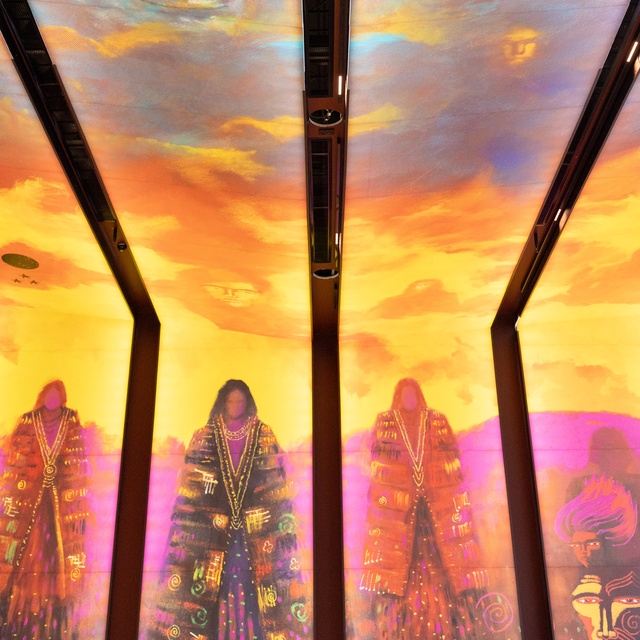
A person stands indoors looking up at three large, brightly colored vertical digital artworks depicting stylized figures in vibrant reds, purples, and golds. The illuminated panels dominate the space with bold patterns and warm light.

Earth Mothers, located in Ngā Pou Ruahine, Te Papa Tuarua | Level 2

Te Matapihi ki te Ao Nui welcomes visitors into a layered journey through the natural world. Through commissioned artworks, bespoke design, and shifting palettes, the building reveals the vital role of microorganisms, the histories of Taranaki Whānui, and the interconnectedness of all living things.

RAWA

At the heart of Te Matapihi ki te Ao Nui is a guiding intention: to bring people toward an understanding of the smallest micro-organisms that give life to the environment around us.

Co-designed with Tihei, the building becomes a window into the natural world, welcoming visitors in to cross into nature’s thresholds.

Te Matapihi ki te Ao Nui: A living story of nature, told through art, architecture, and ancestral memory.

A child touches a large interactive digital display showing swirling neon colors, while an adult behind them holds another child who watches the screen. The scene appears in a modern, well‑lit museum or tech exhibit

Each tomokanga - Victoria Street, Te Ngākau, and the Mezzanine - offers a unique introduction to this story. These wind lobbies are lined with hand-notched Southland beech profiling that draws visitors inward. Within each entrance, a commissioned rawa translates the mana and significance of fungi, lichen, and native flora and fauna through diverse artistic forms.

This narrative continues on the second floor in Ngā Pou Ruahine, where another commissioned rawa is paired with the same bespoke timber profiling, reinforcing the building’s thematic thread. Nearby, the entrance to the Māori collection is framed by intelligent bookend designs featuring hand-drawn and digital depictions of birds, plants, insects, fungi, forests, and rivers. These elements create a heightened sense of arrival and signal the significance of this reference area. Commissioned artists closely connect to the ahi kā of Taranaki Whānui, whose narratives shape the land on which Te Matapihi stands. As visitors move throughout the building, echoes of local history, worldview, and whakapapa accompany them.

Design cues shift subtly as visitors ascend the floors. Carpet and wall palettes transition into vibrant oranges and sky reds, mimicking the forest canopy where light filters through upper branches and mycelial networks to reach the sky.

Externally, the story extends further. Repurposed stone plinths form the trunks of the nīkau trees above them, some etched with sandblasted kōrero or imagery that speaks to what lies within the building. At the Victoria Street entrance, niho tupua designs in the paving act as wayfinding while hinting at a suspended rawa inside.

On the southern façade, a large commissioned rawa explores themes of identity loss. Confronting in its presence, it ‘bites’ at the busy restaurant district opposite, challenging passersby to acknowledge the impacts of colonisation.

Throughout bookable meeting rooms, Autex panels depicting native birds and insects connect each space back to the overarching story of the natural world. These quiet details ensure that every part of the building contributes to the unfolding narrative.

What first appears to be a library reveals itself, with movement, as something richer: a multisensory journey through histories, ecologies, and the unseen forces that sustain life. Each rawa and design element is an elevation carried in from ancient winds - carrying with it the deeper story of Te Matapihi ki Te Ao Nui.

The Rawa

Rawa artists

The artists behind the artwork
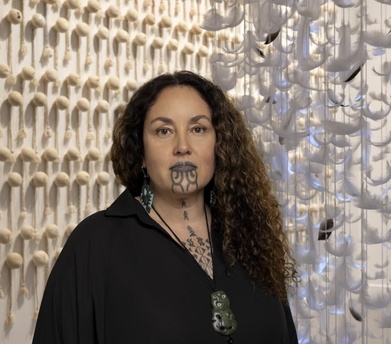
Lady artist in front of artwork

Ngahina Hohaia

Taranaki iwi, Te Āti Awa, Ngāti Ruanui, Ngāti Moeahu, Ngāti Haupoto, Parihaka

Ngahina Hohaia is a celebrated contemporary artist whose practice spans multimedia and multisensory installation, sculpture and weaving. Living in her ancestral community of Parihaka at the foot of Taranaki, she anchors her wide-ranging creative work in traditional knowledge and whakapapa, maintaining a deep connection to place.
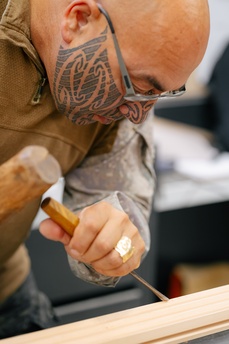
A person uses a chisel and wooden mallet to carve a piece of wood in a workshop, focused intently on their craft.

Tihei

Te Āti Awa, Taranaki Whānui

Rangi Kipa (Tihei) is a renowned artist whose work is highly esteemed across Aotearoa. He is deeply involved in advancing Māori art, helping to revitalise and specialise in several traditional practices, including the unique Taranaki carving style. His deep practise in sculpture, carving and tā moko, but also extends into innovative co-design for public buildings and civic spaces.
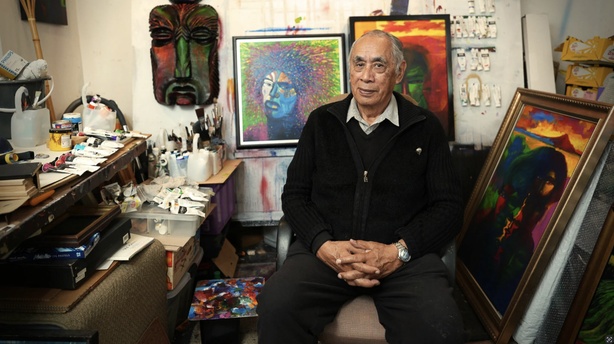
Darcy Nicholas (QSO)

Darcy Nicholas (QSO)

Te Āti Awa, Ngāi Te Rangi, Taranaki, Ngāti Ruanui, Ngāti Hauā

Originally from Waitara in Taranaki, Darcy Nicholas has been a central figure in contemporary Māori art since the late 1960s, reshaping the visual language of Māori art for contemporary expression. A highly regarded artist, he has exhibited extensively across Aotearoa and overseas, been the subject of a documentary and published a book, Land of my Ancestors.
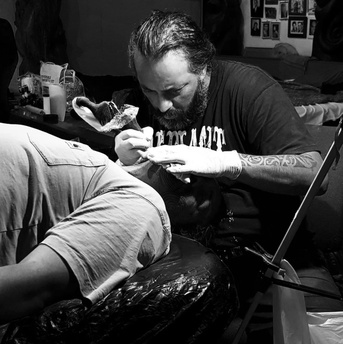
A tattoo artist wearing gloves works on the back of a person lying on a padded surface. The scene is in a dimly lit studio with equipment, artwork, and supplies visible in the background.

Wiremu Barriball

Te Āti Awa, Ngāti Raukawa, Te Rarawa

Wiremu Barriball is a Māori visual artist and musician from the Kāpiti Coast, known for his skill as a tā moko practitioner and his background in graphic design and illustration. His work seeks to transform the ideas and concepts held in tradition in contemporary expressions of Māori today, and his tā moko expertise can be found on media not traditionally seen – shell, wood, stone and leather.
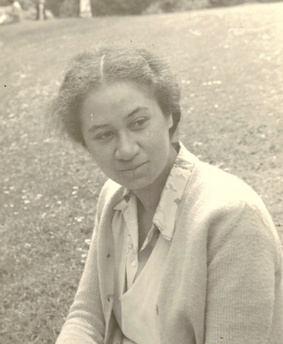
A vintage black‑and‑white photograph showing a person outdoors on grass, wearing a light‑colored collared shirt and jacket. The image has a soft, aged appearance with natural lighting and a shallow depth of field.

Jaqueline Cecilia (J.C.) Sturm 1927 – 2009

Taranaki iwi, Te Āti Awa, Ngāti Ruanui, Te Pakakohi, Te Whakatōhea - Ōpōtiki mai Tawhiti

Sturm - also known as Te Kare Papuni - first joined the Library when it operated from what is now the City Gallery building, later working in Te Matapihi ki te Ao Nui. As one of Aotearoa’s earliest Māori librarians, she became Wellington’s principal New Zealand Room librarian in 1972.

A vibrant ceiling mural shows two large ethereal faces in blue clouds above three robed figures in warm sunset colors, divided by structural beams. The artwork blends spiritual imagery with bold, vivid hues.